web render
This block is part of the web group and was last modified in core v15.0.1.
web render v15.0.1 Renders the page template on the server and answers the request with the finished HTML: title, description, canonical link, Open Graph and Twitter tags, hreflang links and JSON-LD are written for you. Custom pins become template variables.
- flow
- connection
httpconnectionrequired - template
valueThe page template (HTML with {{mustache}}). Leave unwired to use the template stored on this block.
- data
objectThe template's variables.
- title
valuePage title:
<title>, og:title. - description
valueMeta description and og:description.
- image
valueShare image (og:image, twitter:image). A /path becomes an absolute URL.
- canonical
valueCanonical URL; defaults to this page's URL without query.
- layout
valueName or GUID of a stored template that wraps the page; it prints the page with
{{{body}}}. - meta
objectMore head tags as {name: content}, e.g. {"robots": "noindex", "og:type": "product"}.
- JSON-LD
objectStructured data written as application/ld+json.
- status
numberHTTP status code.
- cache seconds
numberHow long shared caches may keep the page. 0 (default): browsers revalidate with the ETag every time.
- headers
array<object>Extra response headers, [{key, value}].
- flow
- connection
httpconnection - html
valueThe finished HTML document.
- success
condition - error
value
Renders the `template` pin (or, when unwired, the template stored on the block's `html` field) with the web template engine: Mustache ({{x}} escaped, {{{x}}} raw, {{#list}}..{{/list}}, {{^x}}) plus {{if a == 'b'}}..{{else if}}..{{else}}..{{/if}}, {{for item in items}}..{{else}}..{{/for}}, {{@index}}/{{@number}}/{{@first}}/{{@last}}, {{> name}} partials (stored web templates by name, or {{define "name"}} blocks), {{t "key" n=count}} translations, and filters {{price | money "EUR"}}, number, date "DD-MM-YYYY", upper, lower, truncate N, default x, json, join, length, nl2br, urlencode, plus/minus/times/divide, round, slug. Escaping follows the HTML context: javascript: URLs are refused, <script> code gets JSON (write `const x = {{x}};` without quotes). Compile errors: a {{> partial}} anywhere but where text goes; if/else or section branches that end in different HTML places (open and close tags inside each branch); a URL scheme formed by data (write `https://{{host}}`). Template variables: the `data` object's fields, every custom pin by id, `web` {language, nonce, url, path, origin, action, signed_in}, and title, description, nonce, language, head. Document: a template starting with <!doctype or <html is the whole document; else `layout` (a stored template by name or GUID, the same documents mail templates use, rendered with {{{body}}} = the page and {{{head}}} = the head tags; also the block's template_guid) wraps it; else a plain HTML5 shell. Head tags (title, meta description, canonical = the page URL unless set, og:*, twitter:*, hreflang alternates, JSON-LD from `json_ld`, `meta` extra {name: content}, the runtime script and prefetch rules) go where {{{head}}} is, else before </head>; a tag the markup's head already has is not repeated. Response: `status` (default 200), `headers` [{key,value}], `cache` seconds (>0 lets shared caches keep it; ignored for a signed-in visitor), ETag with 304, a per-response CSP nonce (write nonce="{{nonce}}" on inline scripts; inline on* handlers are blocked). A template error renders a 500 page that names it and sets success=false, error. Out-pin html is the finished document. Outside a web page (an API endpoint flow) it answers its connection with text/html instead.
render html |
html template |
web template |
server side render |
ssr |
og tags |
seo |
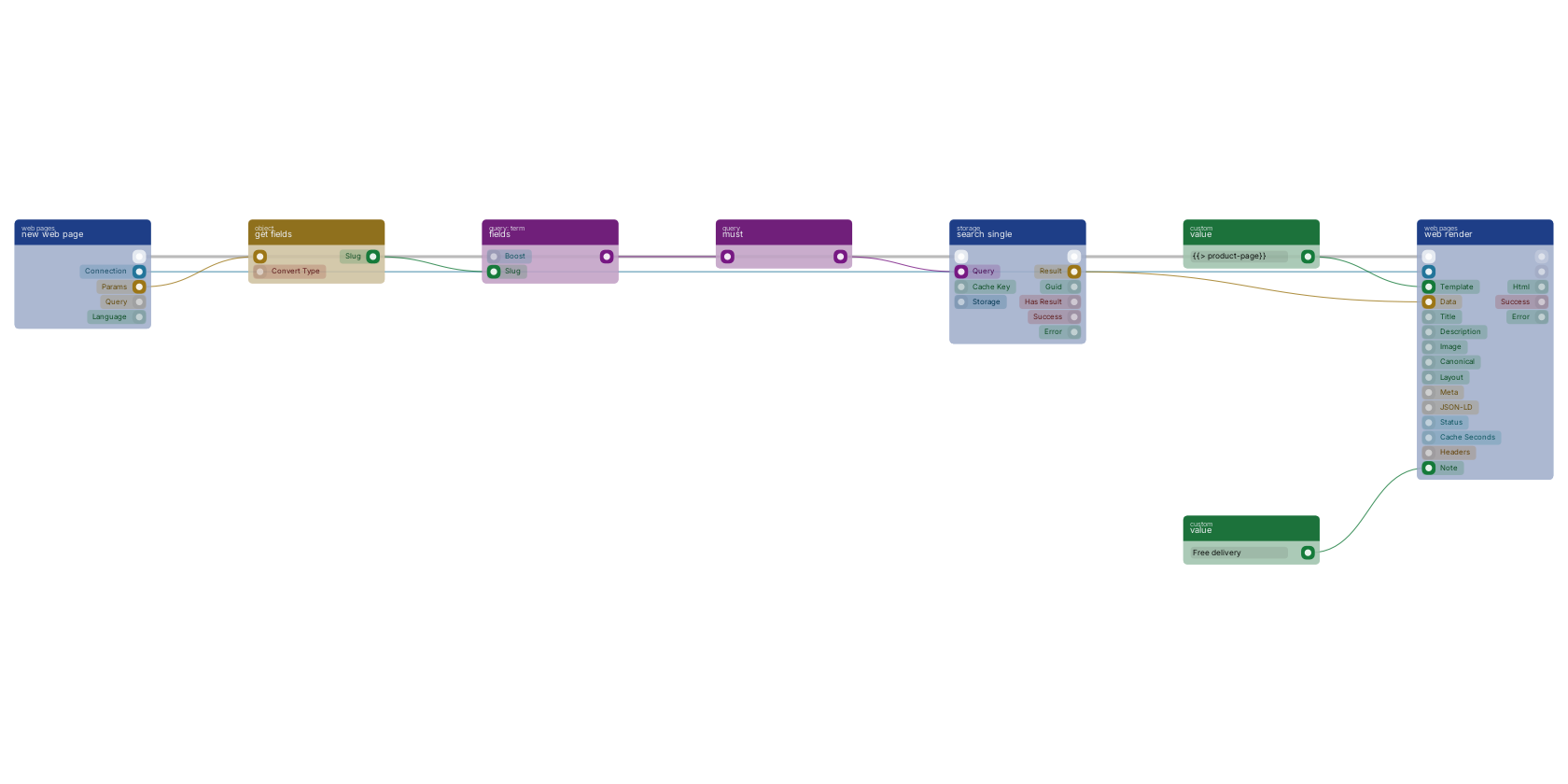
The page reads :slug off its params with get fields, and search single finds the document. web render then answers the request: the fields of the object on its data pin become template variables, and a custom pin, here note, adds a value of your own. The template is a value that names a stored partial. The head tags are written for you from the title, description and image pins. A template error renders a 500 page that names it and turns success off.
Used in these guides
These documentation pages use or explain this block:
- Building a Dashboard with Charts
- Building a Login Page
- Building User Authentication
- Escaping and Security
- Forms and Validation
- How Web Pages Work
- Layouts and Partials
- Migrating from State Pages
Version history
Introduced in v15.0.1.
v15.0.1: block added in this release.
Back to
web Return to the main group to view all sub-groups Back to web pages Return to the group to view all blocks within this group