Assets: Files in Your Cluster
Store files on your cluster and serve them anywhere: public assets on the /static/ path, private assets behind scopes: uploaded in RUAL Studio or managed through the asset APIs.
What Are Assets?
Assets are files stored centrally on your cluster. Because blueprints are distributed across multiple nodes hosted in various regions, keeping files next to a single node does not work: assets solve this by making every uploaded file available to all your blueprints and all your connected domains, with automatic storage and robust security measures.
There are two kinds of assets:
- Public assets live in the
publicfolder. They are served over HTTP from every connected domain under the/static/path: no login or token required. - Private assets live anywhere except the
publicfolder. They are never served directly over HTTP; only your blueprints can read them, so you decide exactly who gets access.
Typical uses are images and fonts for your user interfaces, downloadable files such as exports and invoices, and generated reports you want to keep behind a login.
All public files, regardless of their format, are accessible from all your connected domains using the /static/ path, which maps to the root of the public folder. Referring to the file tree below, the stylesheet is served at /static/styles/mobile.css, while the report in system_assets has no public URL at all.
Uploading Assets in RUAL Studio
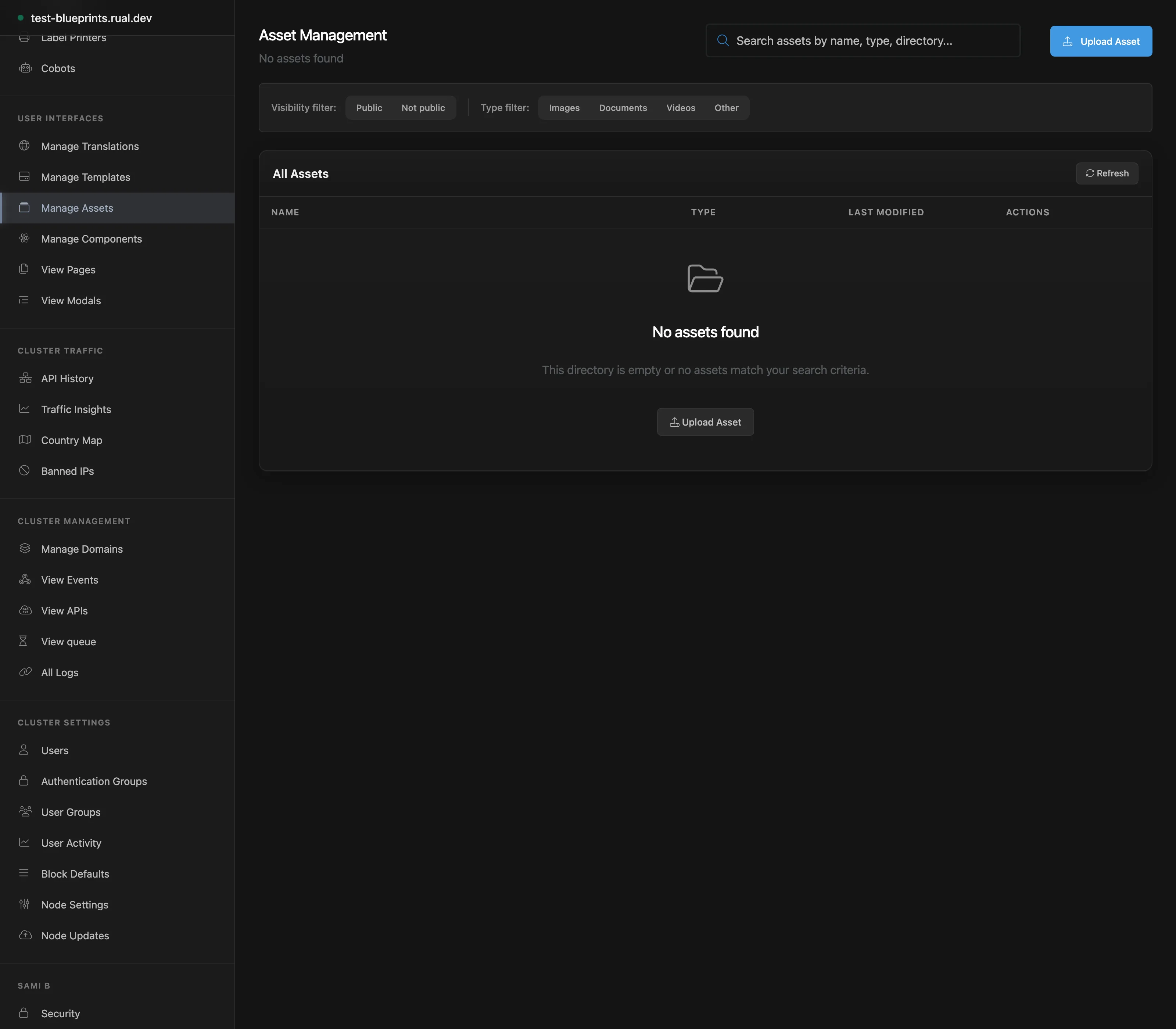
The Manage Assets section in RUAL Studio is where you organize folders, upload files, and inspect what is stored on the cluster.
- Open RUAL Studio and go to Manage Assets. You see the asset folder tree, including the
publicfolder, and the files inside the selected folder. - Select the folder you want to upload to: or create a new subfolder first. Remember: anything placed inside
publicbecomes publicly available. - Click Upload and pick one or more files from your device.
- Confirm the upload. The files appear in the file list and are stored on the cluster immediately.
- Select an uploaded file to open its detail view, where you can review the file metadata and, for public assets, copy the
/static/URL.
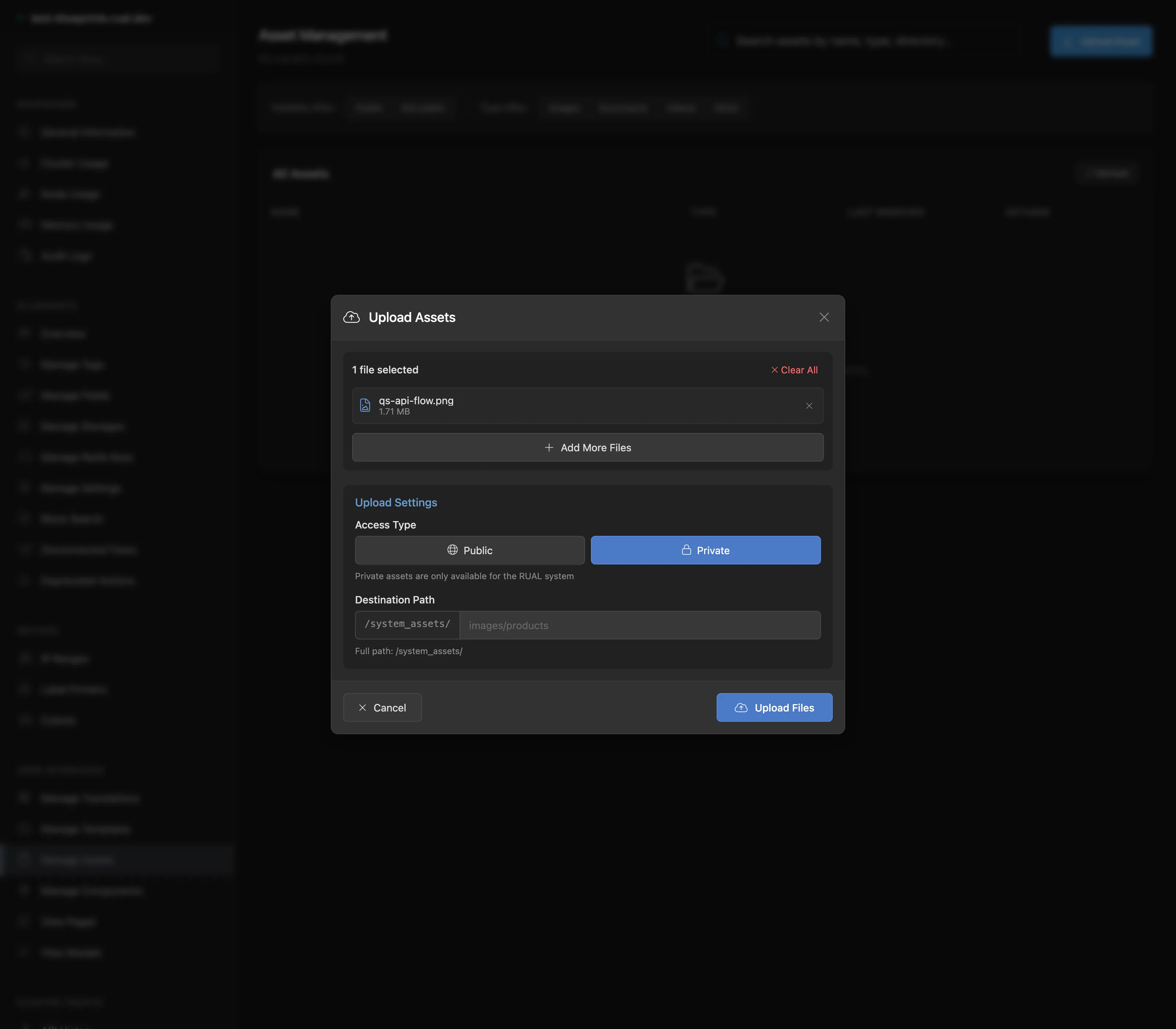
public folder is world-readable on every connected domain. Never store files containing personal data, credentials, or other sensitive content there. Keep those in a private folder and serve them through a scoped blueprint, as described in Serving Protected Files. Managing Assets with the API
For scripted uploads, integrations, and housekeeping, the cluster ships built-in asset APIs under the System Assets category. All of them require an access_token. See Getting Access: and the token's user needs the matching scope: assets_create to upload and search, assets_remove to delete.
| Endpoint | Purpose | Required scope |
|---|---|---|
POST /api/v1/_system/assets/stream |
Upload a file with streaming support (max 500MB) | assets_create |
POST /api/v1/_system/assets/search |
Search and list uploaded assets | assets_create |
DELETE /api/v1/_system/assets/{guid} |
Delete an asset from filesystem and database | assets_remove |
Uploading a File
The upload endpoint takes the file as multipart/form-data and the metadata as query parameters:
| Parameter | Required | Description |
|---|---|---|
filename |
yes | Original filename, URL encoded. |
filesize |
yes | File size in bytes; the maximum is 500MB. Larger uploads are rejected with FILE_TOO_BIG. |
directory |
yes | Target directory: public, system_assets, or temp. |
filetype |
no | MIME type. When omitted, it is detected from the file extension. |
path |
no | Custom subdirectory below the target directory, URL encoded. |
action |
no | Blueprint action GUID; creates a blueprints subfolder for the upload. |
curl -X POST "https://<cluster-url>/api/v1/_system/assets/stream?filename=mobile.css&filesize=4821&directory=public&path=styles" \
  -H "Authorization: Bearer <access_token>" \
-F "file=@mobile.css"{
"assets_guid": "9f8e7d6c5b4a3210",
"name": "mobile.css",
"type": "text/css"
}The returned assets_guid identifies the stored asset. Keep it when you want to delete the file later. Uploading to directory=public makes the file available at /static/<path>/<filename> right away; system_assets keeps it private.
Searching Assets
The search endpoint accepts a query string with paging, so you can list folders or find a specific file:
{
  "limit": 25,
  "offset": 0,
  "query": "logo"
}
Set "count": true to get the number of matching assets instead of the results. limit defaults to 50 and accepts up to 1000.
Deleting an Asset
curl -X DELETE "https://<cluster-url>/api/v1/_system/assets/9f8e7d6c5b4a3210" \
  -H "Authorization: Bearer <access_token>"
A successful delete returns the removed guid; an unknown guid returns 404. The full request and response schemas live under System Assets APIs.
Public vs Private Assets
| Public | Private | |
|---|---|---|
| Location | The public folder (API: directory=public) |
Any folder outside public (API default: system_assets) |
| URL pattern | https://<cluster-url>/static/<path> on every connected domain |
No direct URL: readable only by blueprints |
| Who can access | Everyone, without login or token | Only the flows you build; gate them with *loggedin or custom scopes |
| Typical use | Images, stylesheets, fonts, public downloads | Internal documents, user-specific exports, reports |
The rule of thumb is simple: the public folder decides everything. A file inside it is public no matter what; a file outside it can never be reached by URL guessing, because the /static/ path only maps into public.
Serving Protected Files
To give selected users access to a private asset, serve it through a blueprint and put access control on that blueprint:
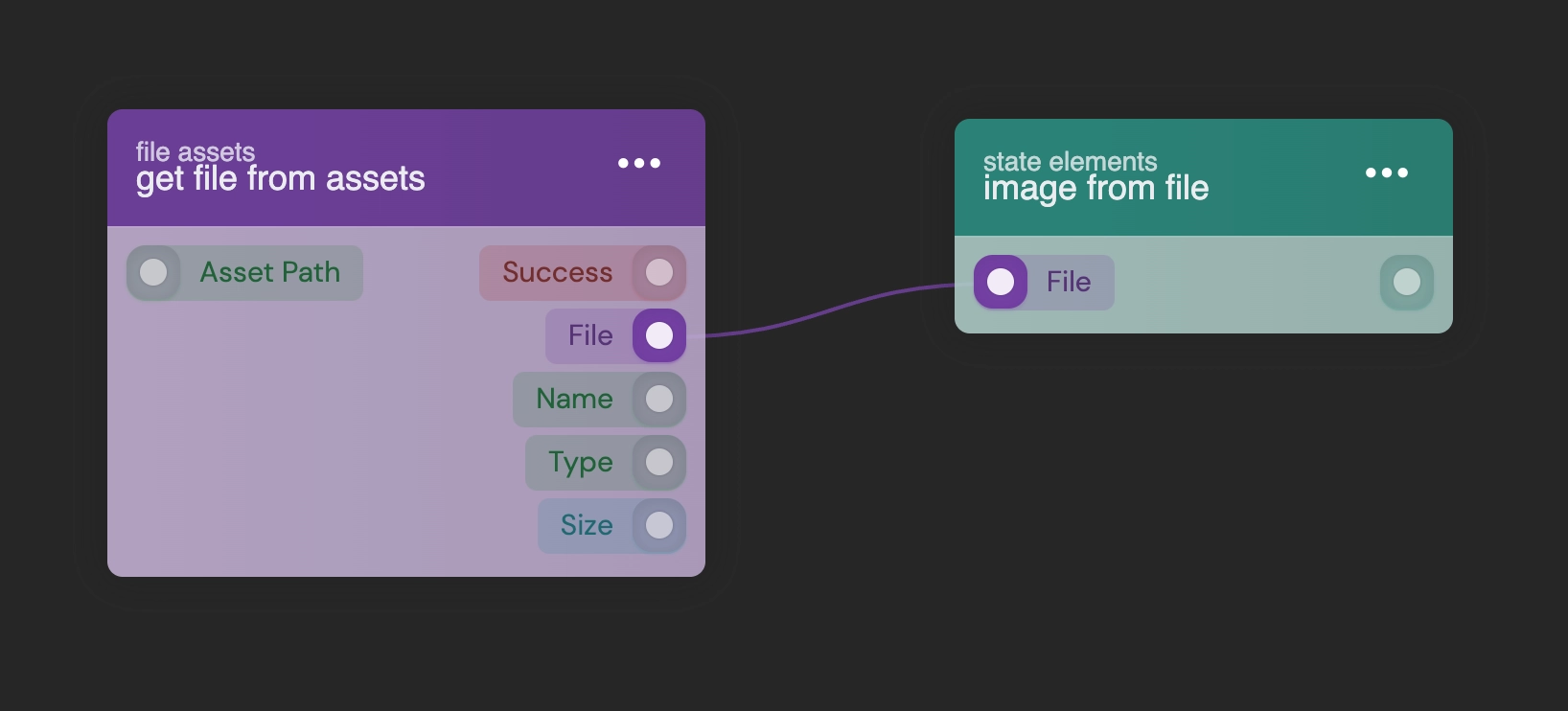
- Create an API or page that loads the file with the get file from assets block and returns it to the caller.
- Click the lock icon on the block and assign
*loggedin, any logged-in user: or a custom scope such asreports, so only users carrying that scope can call it. See Remote Access Control for the full scoping tutorial. - Users without the scope are redirected to the forbidden access page (
/403).
For downloads straight from the browser. An <a> tag cannot set an Authorization header. Pass the token in the URL instead: ?access_token=<token>. Tokens are valid for 14 days and extend automatically while actively used; all five ways to provide a token are documented in Adding tokens to your requests.
Using Assets in Blueprints
The get file from assets block (type file_from_assets, searchable by its alias assets, introduced in v10.4.28) makes files from assets accessible in blueprints. Give it the local path and it hands you a file you can show in the UI or return from an API:
- In-pin: asset path (
value, required): the local path to the asset, e.g./public/images/image.pngor a private path outside the public folder. - Out-pin: success (
condition): the asset exists. - Out-pin: file (
file): the file, ready to be used by UI blocks or API responses. - Out-pins. Name, type, size (
value,value,number): the filename, the asset type, and the size in bytes.
Public assets can be referenced directly in the UI through their /static/ URL without any block. The block earns its place with private files: it is the only way to pull them into a flow, which is exactly what keeps them protected.
Organizing Folders
A consistent folder layout pays off once assets pile up. Recommended conventions:
- Group by purpose, not by date or uploader:
public/styles,public/images,public/downloadsfor public files, and folders likereportsorexportsnext to. Never inside:publicfor private ones. - Name for URLs: use lowercase names with hyphens instead of spaces. Folder and file names below
publicbecome part of the/static/URL verbatim. - Remember the prefix mapping:
/static/points at the root ofpublic, sopublic/styles/mobile.cssis served as/static/styles/mobile.css. Thepublicsegment itself never appears in the URL. - Keep user-generated content out of public unless it is genuinely meant for everyone; move it through a scoped blueprint instead.
File Size, Formats & Performance
- Size limit: the upload API accepts files up to 500MB per file and rejects larger ones with
FILE_TOO_BIG. For anything near that limit, prefer the streaming endpoint over base64-style uploads. - Image formats: serve images as
webp: dramatically smaller than PNG or JPEG at the same quality. Thefunction_image_to_webpandfunction_resize_imageblocks convert and resize images in a flow, so you can normalize user uploads before storing them. - Documents: distribute documents as PDF; it renders consistently on every device and browser.
- Immutable URLs: public assets are ideal CDN and browser-cache candidates because every connected domain serves the same bytes. Give files that change over time a version in the filename:
app.v3.cssinstead ofapp.css: so clients can cache each version aggressively and you never wait for stale caches to expire. Upload a new name, deploy, and the new URL takes effect immediately.
Working With Video
Video is the one upload type where storing what arrived is usually the wrong move: a phone clip is often twenty times larger than it needs to be, and serving it as uploaded costs bandwidth on every view. Three blocks cover the normal pipeline, and the split between them matters because two are cheap and one is not.
| Block | What it does | Where it runs |
|---|---|---|
video_probe |
Reads width, height, duration, size and whether the file has an audio track. It reads the file's own header rather than its contents, so nothing is decoded. | Inline, in milliseconds |
video_thumbnail |
Writes one frame out as a JPEG poster image. Pick the timestamp; a timestamp past the end of the clip falls back to the midpoint rather than failing. | Inline: it decodes a single frame, not the file |
video_compress |
Re-encodes the video, optionally scaling, capping the bitrate and trimming to a range. Presets cover the normal message-media sizes; every setting can be overridden individually. | The queue, as a background job |
Probe first and branch on the answer. A clip already inside your limits does not need re-encoding, and skipping the compression job is always faster than running a good one.
- Compression is a queue job, not a step. The block hands you the job id and the path the output will appear at, and the flow continues. Wire the
on_complete_functionandon_error_functionout-pins to react to the outcome; both fire whether or not the flow waited. - Waiting in the flow is available and rarely what you want. Setting
wait_in_flowblocks until the encode finishes and fills in the output dimensions, duration and size. It is convenient in a scheduled job and a poor idea in a request: a user is waiting on a page while a video transcodes. Give it a timeout when you do use it. - The result out-pins are empty unless you waited. Width, height, duration, size and success are populated by the job, so a flow that did not wait reads them from the callback instead.
- Both file pins take either shape. A file object from another file block, or a path relative to the entity root. Thumbnails written below
publicare servable straight from the/static/URL. - Trim to enforce a maximum length, do not check afterwards. The start and duration pins cut the clip as part of the encode. Without them a twenty-minute upload is transcoded in full and can only be rejected once the work is already done, which is the expensive order to discover it in.
- Pass context through rather than storing it. The
passthroughin-pin is handed to the callback verbatim, which is how the completion function knows which document the clip belonged to.
Next Steps
Remote Access Control Gate pages and APIs behind *loggedin or custom scopes. System Assets APIs Full request and response schemas for the asset upload, search, and delete endpoints. get file from assets Pin reference for the block that loads cluster assets into a blueprint.Frequently asked
How do I serve a file from RUAL?
Upload it as an asset in RUAL Studio or through the asset APIs. Public assets are served from the /static/ path, and private assets stay behind scopes so only authorised callers can fetch them.