request: delete
This block is part of the webhooks group and was last modified in core v15.0.0.
request: delete v12.1.6 Updated v15.0.0Performs an HTTP DELETE request to remove a resource at the specified URL. Returns the response as a string value.
- flow
- URL
valuerequired - Auth. header
valueHidden when unused
- Query String
objectHidden when unused
- skip ssl
conditiontruewill skip SSL verification • Hidden when unused - include token
conditionv12.1.6truewill include current users access token in header, to support internal RUAL endpoints requests • Hidden when unused - timeout
numberv14.0.1Overwrites the default timeout. Time in seconds. Capped by the cluster setting "Default HTTP Timeout" (http_timeout_in_seconds, 120s when unset) : a higher value is clamped to it and logged. • Hidden when unused
- retry
conditionv14.0.4Enable automatic retry on failure. Uses exponential backoff. • Hidden when unused
- retry count
numberv14.0.4Maximum number of retry attempts. Default is 3. • Hidden when unused
- retry delay
numberv14.0.4Initial delay between retries in seconds. Uses exponential backoff (delay doubles each retry). • Hidden when unused
- signing key
valuev15.0.0When set, signs the request with HMAC-SHA256 for RUAL-internal APIs (e.g. the mssgs backend): adds
X-Mssgs-Timestamp(Unix seconds) andX-Mssgs-Signature: sha256=<hex>computed overtimestamp\nmethod\nrequest URI\nbody. • Hidden when unused
- flow
- code
number - response
value - headers
objectThe replied headers of the request
request |
http delete |
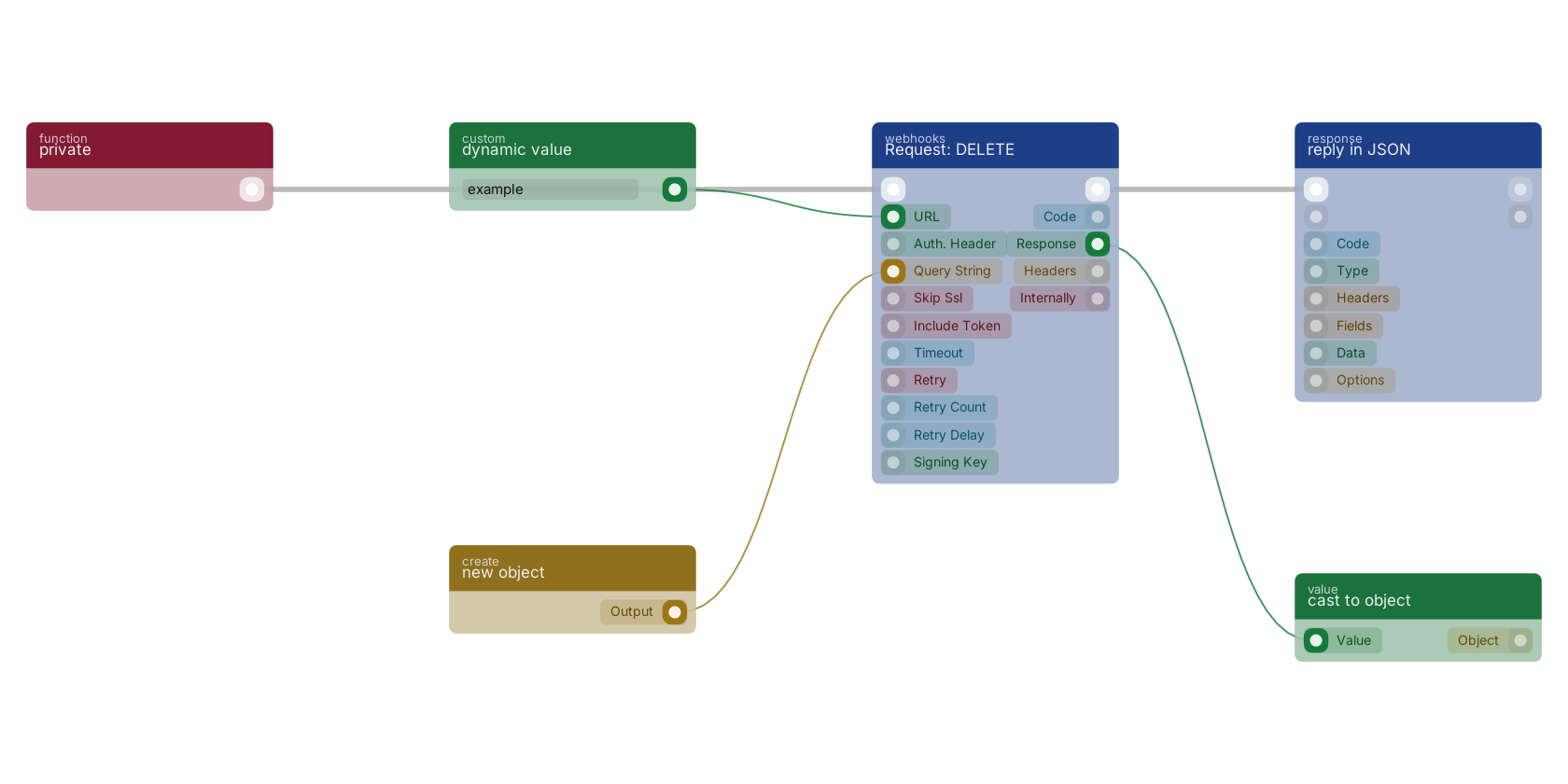
A typical wiring for Request: DELETE: new object feeds the querystring pin; dynamic value feeds the url pin; the flow out pin feeds reply in JSON; the response out pin feeds cast to object.
Commonly used with
In production blueprints, this block is most often wired together with:
- reply in JSON: this block feeds into it. Reply to any httpconnection as JSON body.
- new object: feeds into this block. Builds a new object filled with the given fields.
- create: feeds into this block. Creates a new function that can be executed using the given name.
- cast to object: this block feeds into it. Converts the given value into an object.
- dynamic value: feeds into this block. Returns the provided value with support for dynamic inpins using {name:type} placeholders — the pin's name first, then its type, e.g. {guid:value}.
Version history
Introduced in v12.1.6.
Last modified in v15.0.0.
v14.0.4, click here to see the release notes. v14.0.1 This block or one of its pins was updated in v14.0.1, click here to see the release notes. v13.0.7 This block or one of its pins was updated in v13.0.7, click here to see the release notes. Back to
webhooks Return to the main group to view all sub-groups Back to webhooks Return to the group to view all blocks within this group