request: put json
This block is part of the webhooks group and was last modified in core v15.0.0.
request: put json v12.1.6 Updated v15.0.0Performs an HTTP PUT request to create or replace a resource at the specified URL with a JSON body.
- flow
flow - URL required
value - body required
object - Auth. header
valueHidden when unused
- Query String
objectHidden when unused
- headers
objectHidden when unused
- skip ssl
conditiontruewill skip SSL verification • Hidden when unused - include token
v12.1.6conditiontruewill include current users access token in header, to support internal RUAL endpoints requests • Hidden when unused - timeout
v14.0.1numberOverwrites the default timeout. Time in seconds. Capped by the cluster setting "Default HTTP Timeout" (http_timeout_in_seconds, 120s when unset) : a higher value is clamped to it and logged. • Hidden when unused
- retry
v14.0.4conditionEnable automatic retry on failure. Uses exponential backoff. • Hidden when unused
- retry count
v14.0.4numberMaximum number of retry attempts. Default is 3. • Hidden when unused
- retry delay
v14.0.4numberInitial delay between retries in seconds. Uses exponential backoff (delay doubles each retry). • Hidden when unused
- signing key
v15.0.0valueWhen set, signs the request with HMAC-SHA256 for RUAL-internal APIs (e.g. the mssgs backend): adds
X-Mssgs-Timestamp(Unix seconds) andX-Mssgs-Signature: sha256=<hex>computed overtimestamp\nmethod\nrequest URI\nbody. • Hidden when unused
- flow
flow - code
number - response
object - headers
objectThe replied headers of the request
request |
http put json |
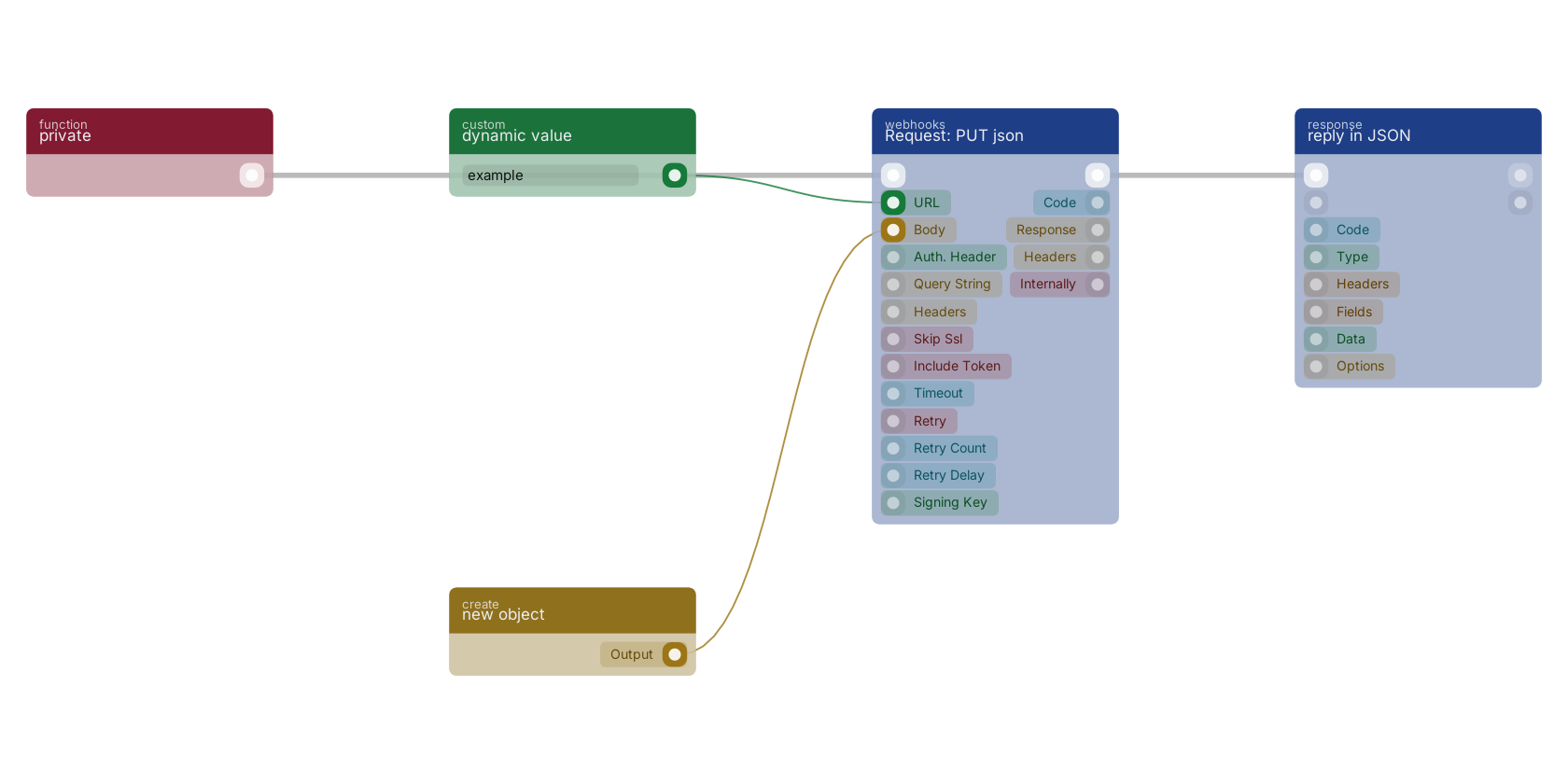
A typical wiring for Request: PUT json: new object feeds the body pin; dynamic value feeds the url pin; the flow out pin feeds reply in JSON.
Commonly used with
In production blueprints, this block is most often wired together with:
- reply in JSON: this block feeds into it. Reply to any httpconnection as JSON body.
- new object: feeds into this block. Builds a new object filled with the given fields.
- create: feeds into this block. Creates a new function that can be executed using the given name.
- dynamic value: feeds into this block. Returns the provided value with support for dynamic inpins using {name:type} placeholders — the pin's name first, then its type, e.g. {guid:value}.
Version history
Introduced in v12.1.6.
Last modified in v15.0.0.
v14.0.4, click here to see the release notes. v14.0.1 This block or one of its pins was updated in v14.0.1, click here to see the release notes. v13.0.7 This block or one of its pins was updated in v13.0.7, click here to see the release notes. Back to
webhooks Return to the main group to view all sub-groups Back to webhooks Return to the group to view all blocks within this group