open connection
This block is part of the object storage group and was last modified in core v15.0.1.
open connection v15.0.1 Opens a connection to S3-compatible object storage (Ceph RGW, MinIO, Amazon S3). Point it at an object storage service provider so the secret key stays in the provider store and never appears in this blueprint : the key pins are the older way and leave the secret readable to anyone who can open the flow.
- flow
flow - endpoint
valueGateway URL, for example
https://rgw.example.comorhttp://10.0.0.5:8080. A bare hostname is assumed https. Required unless the provider supplies one. An endpoint on a private or internal address must be added to thehttp_outbound_allowlistcluster setting, or calls on this connection are refused. - provider
valueName of an object storage service provider (Settings → Service Providers). Preferred: the keys are resolved when a call is made and never land on a pin.
- access key id
valueLiteral access key. Only used when no provider is named. Stored in plaintext in this blueprint.
- secret access key
valueLiteral secret key. Only used when no provider is named. Stored in plaintext in this blueprint.
- session token
valueOptional. Only for temporary (STS-issued) credentials; Ceph RGW does not issue them.
- region
valueSigning region. Defaults to
us-east-1, which RGW accepts and ignores unless it is configured with zonegroups. - default bucket
valueOptional. Used by every block on this connection that leaves its own bucket pin empty.
- path style addressing
conditionOn (the default) puts the bucket in the URL path : required for Ceph RGW and MinIO. Off uses
bucket.hostvirtual-host addressing, which needs a wildcard DNS entry and matching certificate.
- flow
flow - connection
s3connectionThe same connection, so it can be passed to the next block.
- success
conditionFalse when no credential was given, the endpoint is missing or malformed, or the named provider does not exist, is disabled, or is not an object storage provider.
- error
value
Opens an S3-compatible object storage connection and emits it on `connection`. Makes NO network call : it only validates and normalizes, so a wrong endpoint or a down gateway surfaces at the first block that uses the connection, not here. Credentials come one of two ways and they are not equivalent: `provider` names an object_storage service provider and the connection carries only that NAME (the secret is fetched per call and never lands on a pin or in a simulation trace : use this), while `access_key_id`+`secret_access_key` embed literal keys in the blueprint in plaintext. `endpoint` is required unless the named provider supplies one. `path_style` defaults to TRUE (bucket in the URL path), which is what Ceph RGW and MinIO need; set it false only for Amazon S3-style virtual-host addressing, which requires a wildcard DNS entry per bucket. `bucket` here is a DEFAULT that every downstream block inherits when its own bucket pin is empty. success=false with error NO_CREDENTIAL, MISSING_ENDPOINT, or a PROVIDER_* code when the connection cannot be built; `connection` is then null. DEPLOYMENT: outbound calls go through the cluster SSRF guard, which refuses loopback, private and link-local addresses. An RGW on an internal range must have its address added to the `http_outbound_allowlist` cluster setting (Cluster Settings → HTTP → Outbound Allowlist) first, or every operation fails with a blocked-address error even though the credentials are correct.
s3 |
rgw |
ceph |
minio |
object storage |
bucket |
blob |
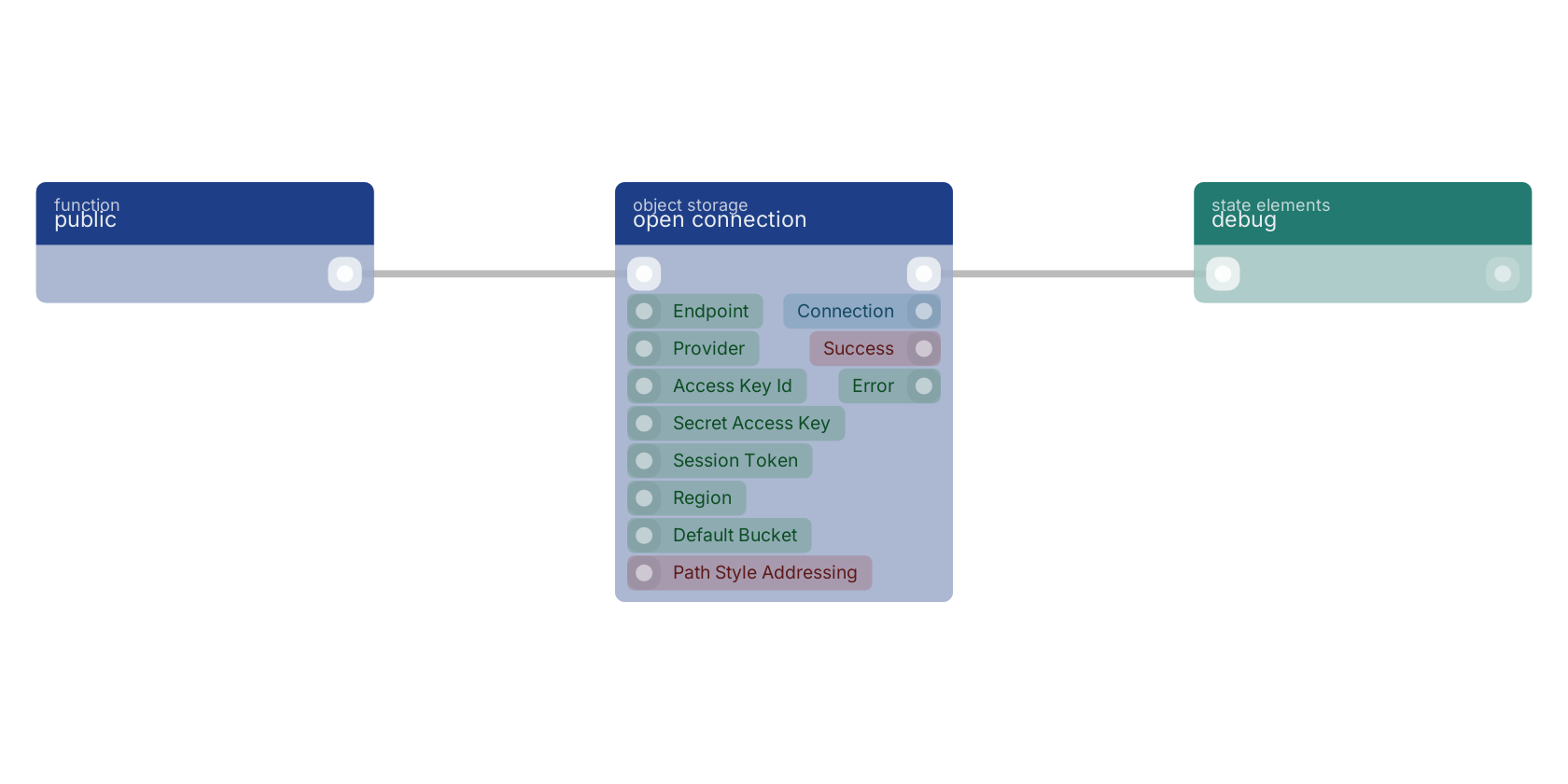
A typical wiring for open connection: a function trigger starts the flow; the flow out pin feeds debug.
Version history
Introduced in v15.0.1.
Service documentation
External API reference This block wraps a third-party service. Click here for the service's own documentation of the underlying endpoint.Back to
object storage Return to the main group to view all sub-groups Back to object storage Return to the group to view all blocks within this group